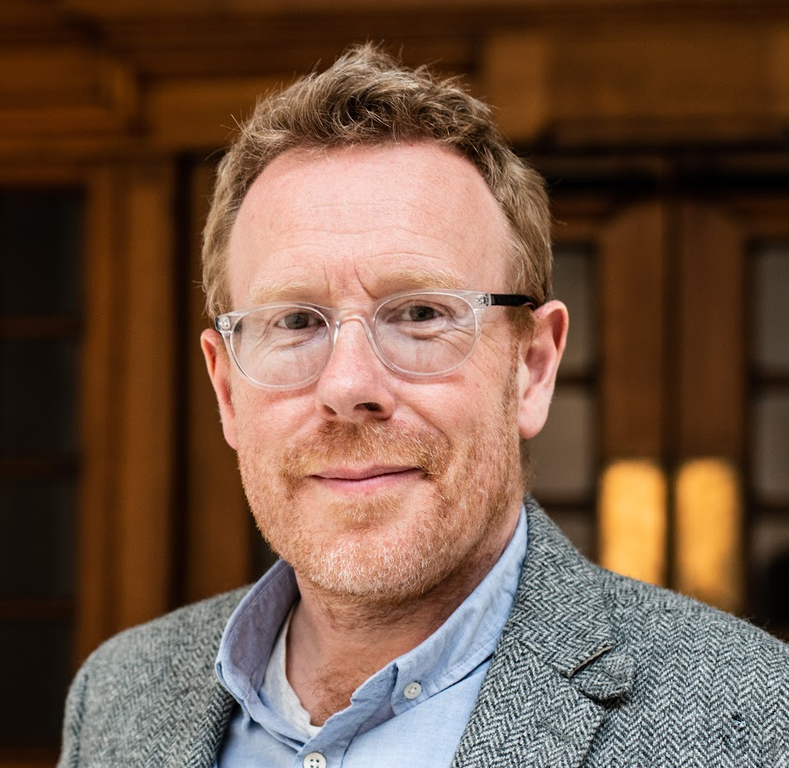
John Byrne
Liverpool John Moores University
Biography
Professor of Useful Art at Liverpool John Moores University's School of Art and Creative Industries. He has spent over two decades developing accessible strategies to make art a useful tool for real-world social change. As the UK's first Professor of Useful Art, he combines active participation in local, national and international useful art projects with a practical and academic interest in ground-up activism and community empowerment. In an era of rising populism and political polarisation, his research offers essential insights into how we might imagine and remake ourselves otherwise - insights brought together in his 2026 book, Useful Art: How activist artists can change the world. Since 2020, has chaired/co-chaired the Advisory Board of Tŷ Pawb, Wrexham's hybrid market, cultural hub, gallery and community garden - grounded in what Byrne terms 'Cultural Sustainability'. From 2019, Researcher and Writer in Residence at The Whitworth Art Gallery, Manchester, where he co-produced the online research platform Decentralising Political Economies (dpe.tools), linking The Whitworth, the Association of Arte Útil and LJMU's IAT. Earlier, coordinated the ‘Constituencies’ research strand in the L'Internationale Consortium of Museum and Galleires EU-funded project The Uses of Art: The Legacy of 1848 and 1989 (2013–2018).
Sessions
Useful Art as a Toolkit for Cybernetic Change: A Viable Systems Model for a Better World Today
This paper asks whether past utopias can serve as a portal for reimagining how today's high-powered technologies — AI, quantum computing, and beyond — might be redirected toward building a better world. Rather than one-size-fits-all, top-down, financialised solutions imposed by tech bros and populist leaders, it proposes a decentralised model rooted in real-world local innovation: linked micro-activisms empowered with ground-up capabilities, enabling dialogue to genuinely reach power. Central to this inquiry is the Cybersyn archive, approached as a site of latent potential for clarifying our present predicament. Drawing on Walter Benjamin's insistence that excavating past utopian dreams is a legitimate — even necessary — method for imagining alternatives, the paper revisits Stafford Beer's Viable System Model and the wider Cybersyn project as a resource for confronting today's complex technological landscape. A key comparative thread runs through the 1970s Latin American World Model (LAWM), developed in response to the Club of Rome's report that the world could not sustain its current trajectory. Where the Club of Rome saw limits, LAWM offered a qualified yes — if certain structural conditions were addressed. This paper argues that new global reports are, in effect, saying the same thing again, and that LAWM's logic remains instructive. Finally, the paper reactivates Marx's concept of the 'General Intellect' to theorise decentralised activist networks as fluid, self-regulating systems — and proposes Useful Art as the toolkit binding these local activisms into a coherent, networked, decentralised political economy. These are ideas which, in one form or another, I've been playing with for over twenty years, drawn together here as a proposal for thinking cybernetically about change, today.