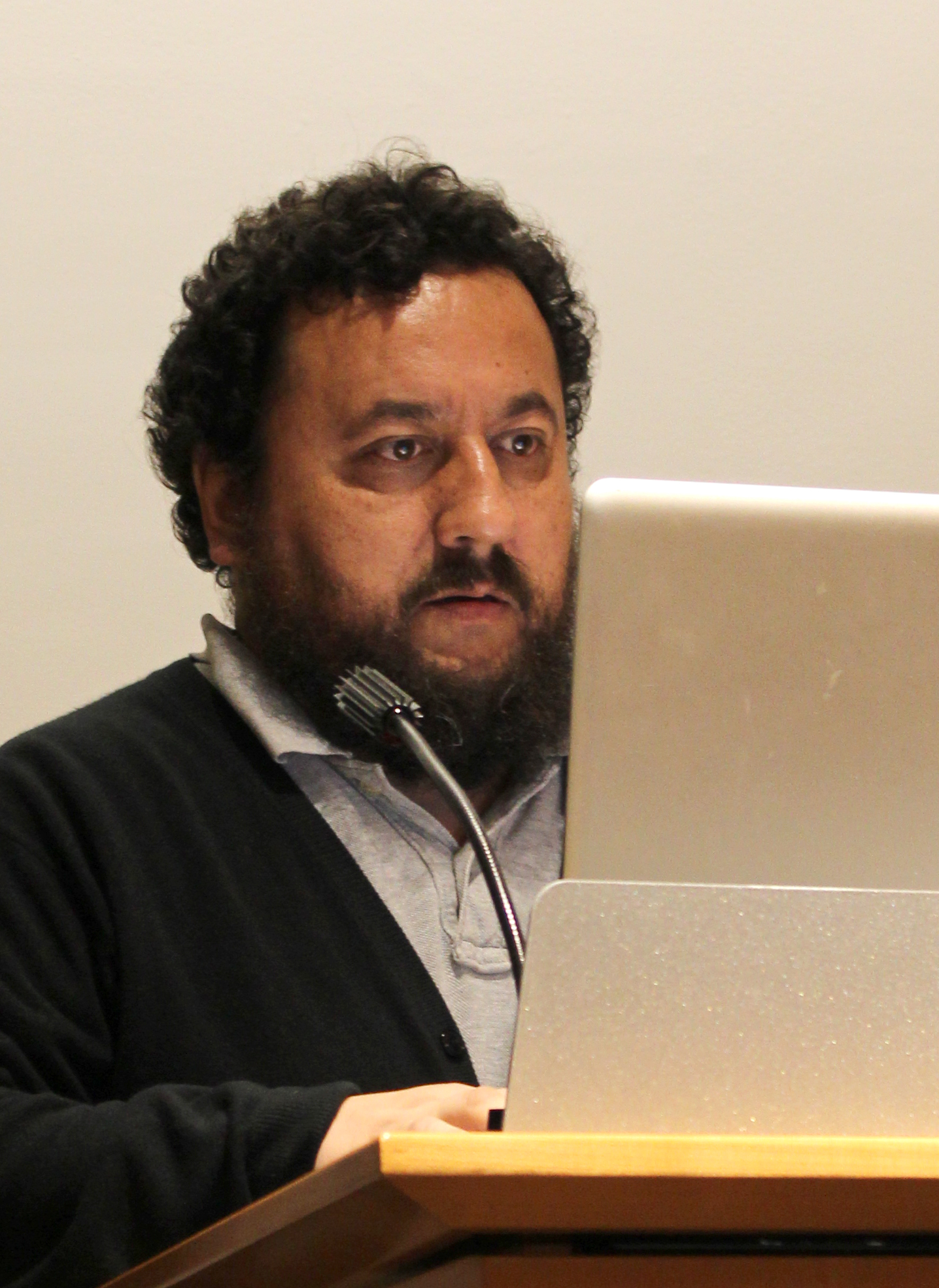
Ricardo Vega Mora
Pontificia Universidad Católica de Chile (PUC)
Biography
Ricardo is a designer, artist, programmer and cultural manager. Ricardo holds MFA Design and Technology (Parsons, The New School), with studies in Information Visualisation and Data Science. He is a professor at the School of Design, and has taught at the School of Engineering, both at Pontificia Universidad Católica de Chile (PUC). He directs the UC Design Data Visualisation Diploma. He is interested in transdisciplinary links, carrying out studies in Philosophy and Sciences. He develops projects at the intersection between visualization, graphics, programming, art and design, exploring the aesthetic representation of data. He is the founder of C80.cl, a project that, since 2015 has used visualisations to support the contextualized understanding of the Chilean Constitution of 1980. He founded Artnumerica.info, oriented to algorithmic design and data visualization. As an artist, he has participated in exhibitions, conferences and presentations in Chile, Argentina, Brazil, Spain, and Estonia. Currently, he is pursuing a PhD in Computational Engineering (double degree) at PUC (Chile) & University of Edinburgh (Scotland).
Sessions
Cybersyn Boxes. Prototyping a Document Visualisation Assisted by AI
The Cybersyn Project records in the Stafford Beer Archive (SBA) at Liverpool John Moores University offer insight into cybernetic and management science thought, capturing the intellectual process behind concepts like the Viable System Model (VSM) through handwritten notes, diagrams, and correspondence. Currently, there is no visualisation that supports relational exploration of these archives, making it difficult to trace how ideas, correspondence, and diagrams connect. Data visualisation is a way to show complex structures visually, facilitating pattern recognition and exploration. This project argues for representing collections like the SBA through visualisation, enabling multi-perspective views of records and going beyond the usual document-by-document viewing. The project explores visualisation to support navigation through these documents, revealing how individual records relate to the whole and how people and concepts connect, and enabling intuitive exploration of complex archives. This project addresses three challenges: (a) adapting knowledge graphs to the archival materials, (b) developing strategies for natural-language querying, and (c) designing automated visualisation. In doing so, it advances research in Visualisation, Human-Computer Interaction (HCI), and Digital Humanities by treating visualisation as a means of knowledge discovery. Building on this, the project clarifies how GenAI, LLMs, and Knowledge Graphs enhance visualisation, opening access to an archive significant to the history of technology in Chile and the world. This proposal seeks to show some of the project's progress, allowing an overview of the potential applications across different areas such as human rights, arts, and the humanities, among others.