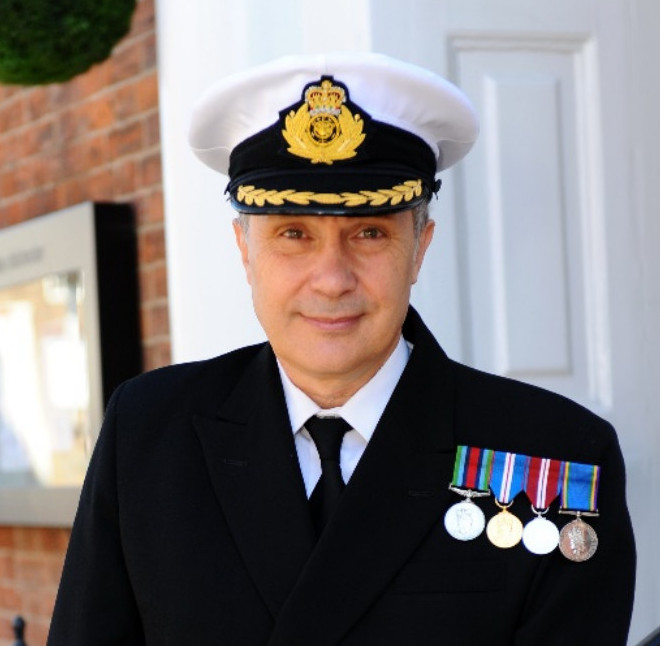
Captain Jonathan Huxley
Biography
Captain Jonathan Huxley PhD (RFA Rtd) is a retired officer from the Royal Fleet Auxiliary. He has spent 47 years at sea from the age of 17, ofwhich 24 were in command as a qualified Master Mariner with Polar Navigation endorsement and specialist Royal Navy Navigation Instructor and SRN4 Hovercraft Navigator. During his career he has worked in a wide variety of theatres from the Atlantic, North America, Mediterranean, Persian Gulf, Sierra Leone, Indian Ocean, Far East, Australasia, Pacific, South Atlantic, Antarctic, South America, and Arctic. Undertaking amphibious operations, afloat support, maritime security, defence engagement, MCM support, aviation, submarine support and special operations. As well as command at sea Captain Huxley has been actively involved in participating in strategic, personnel and change management, developing strategies, implementing change programmes, negotiating with Maritime Trade Unions and interfacing with programmes, negotiating with Maritime Trade Unions and interfacing with government organisations such as the Treasury. His focus during all this work has been examining how groups organise themselves and make decisions. He conducted research into the viability of salient social identities for his doctorate and continues his research studies into group behaviour.
Sessions
A full software implementation of Stafford Beer's Viable System Model (VSM) as a complete enterprise management system
This talk presents a full software implementation of Stafford Beer's Viable System Model (VSM) as a complete enterprise management system, combining a live demonstration with a discussion of the system's capabilities, the methodologies behind it, and the challenges encountered during development. The system is a stand-alone desktop application supporting multiple, freely extensible levels of recursion, with real-time connections to the environment via configurable feeds. It manages a wide range of organisational functions: recursion analysis, process management, task coordination, output control, vertical coherence analysis, and audit of key variables. Connections between the environment and internal systems — and between internal systems themselves — are managed through homeostats built from transductors that use Bayesian decision mechanisms to switch the governing states of processes defining key properties. Where this falls short of covering the full variety of situations, a Pask conversation mechanism is provided to support semantic transduction across boundaries. The system also operates in a manner comparable to project management, but purpose-built for the VSM. It enables resources with defined work patterns and properties to be assigned tasks, goals, and objectives to achieve specific outputs. This supports resource allocation across manpower, materials, information, and ideas. The system is capable of HR management; stock control; financial costing and analysis; monitoring organisational integrity and viability — including simulation of the organisation's operations through forward time projection, and Monte Carlo sweeps across key variables to monitor viability. The talk concludes with a discussion of the future roadmap: evolving the system from a desktop application into a distributed system supporting multiple concurrent users and networked deployment across an organisation. A further direction under consideration is a blockchain-based consensus mechanism to support cooperative, multi-stakeholder decision-making — of particular relevance to organisations such as cooperatives, where authority is distributed rather than centralised.