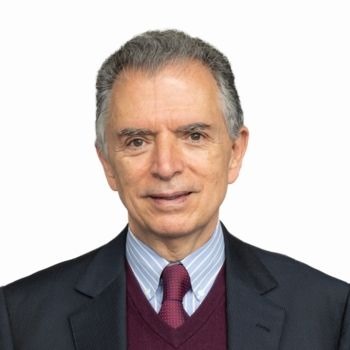
Germán A. Bula Escobar
Universidad del Rosario,Colombia
Biography
An attorney (Universidad del Rosario - Colombia). He holds a doctorate and master's degree in Ethics and Democracy from the University of Valencia (Spain), master’s degrees in economics (National University of Colombia) and in Political Science (IAEE - Madrid). His research lines focus on truth studies and peacebuilding, as well as organizational cybernetics applied to law and public administration. Serves as an arbitrator at the Arbitration Centers of the Chambers of Commerce of Bogotá, Barranquilla, Cartagena, and Pereira. Within the Council of State of Colombia, he has held the positions of President, Magistrate of the Consultation and Civil Service Chamber, and Ad Hoc Justice of the Council of State. He has served as Minister of Education, as well as Deputy Comptroller General of the Republic of Colombia, Ambassador to Venezuela, and Director of the World Center for Research and Training in Conflict Resolution. An active member of WOSC, the Colombian Academy of Jurisprudence, the Ibero-American Forum of Administrative Law (FIDA), and the Franco-Colombian Association of Jurists (AJFC). Author of some books and papers. He serves as a reviewer for international journals. During his professional career he was a professor at several universities, international lecturer, organizational consultant, and litigator.
Sessions
Beer’s Thought in the Colombian Comptroller General Project: Beyond Detecting Corruption—Designing Viable Public Institutions through Organizational Cybernetics (keynote)
A practical application of Stafford Beer’s ideas, the institutional reform undertaken at the Colombian Office of the Comptroller General (1995–1998) represents one of the earliest documented attempts to redesign the supreme audit institution of a nation-state using Organizational Cybernetics. The initiative began when the Comptroller General asked whether cybernetics could provide the conceptual and methodological foundation for a major institutional transformation. Professor Raúl Espejo joined as Scientific Director, while I directed the reform. An outstanding team—including Angela Espinosa, Ernesto Lleras, Alfonso Reyes, and Roberto Zarama—developed the initiative.Drawing upon the Viable System Model, Ashby's Law of Requisite Variety, recursive organization, autonomy, cohesion, structural archetypes (inter alia), the reform redesigned audit methodologies and transformed the training of public auditors. It was further enriched by the participation of Heinz von Foerster, Humberto Maturana, and Markus Schwaninger. The conceptual breakthrough was the shift from first-order control—the inspection of organizational operations—to second-order control: auditing organizations' capacity for self-regulation. Consequently, the purpose of public auditing moved beyond detecting irregularities toward strengthening institutional capabilities and improving organizational performance. Stafford Beer himself summarized this philosophy during his Cartagena address: 'I find it difficult to believe in the idea of pursuing corruption as if it were a dragon to be hunted. Corruption is not an entity; it is a product of the system. The purpose of a system is what it does. So, if the system is not working, let us change the system.'The reform strengthened internal control systems, introduced systemic sector-wide auditing methodologies, and proposed reorganizing the Comptroller General's Office around economic and social sectors rather than administrative entities. As we commemorate Stafford Beer's birth, this Colombian experience demonstrates that Organizational Cybernetics is not merely a theoretical framework but a practical methodology for redesigning public institutions and addressing contemporary governance challenges.